Friday, October 11, 2013

Friday five: gnome hunting (and other fun!) in Wroclaw.

Wroclaw ("Vro-tz-wav"), known as Poland's Venice, was not in our original list of "must-see" places. But we ran across a quirky Wroclaw city map at our hostel in Warsaw highlighting funky street art, bridges galore, and a gnome scavenger hunt. And then we spontaneously decided to go to Prague and Wroclaw was right on the way... To our surprise it ended up being a highlight of Poland.

We got a really good vibe riding the tram from the bus station to our hostel. Warsaw was bustling with activity, but Wroclaw felt alive. In our short stay we would feel some kind of pulse flowing from the river and canals we crossed, the parks we passed through, the weekend events...
  
Senior Day celebration in the square 
(same day as Gnome Day, natch)
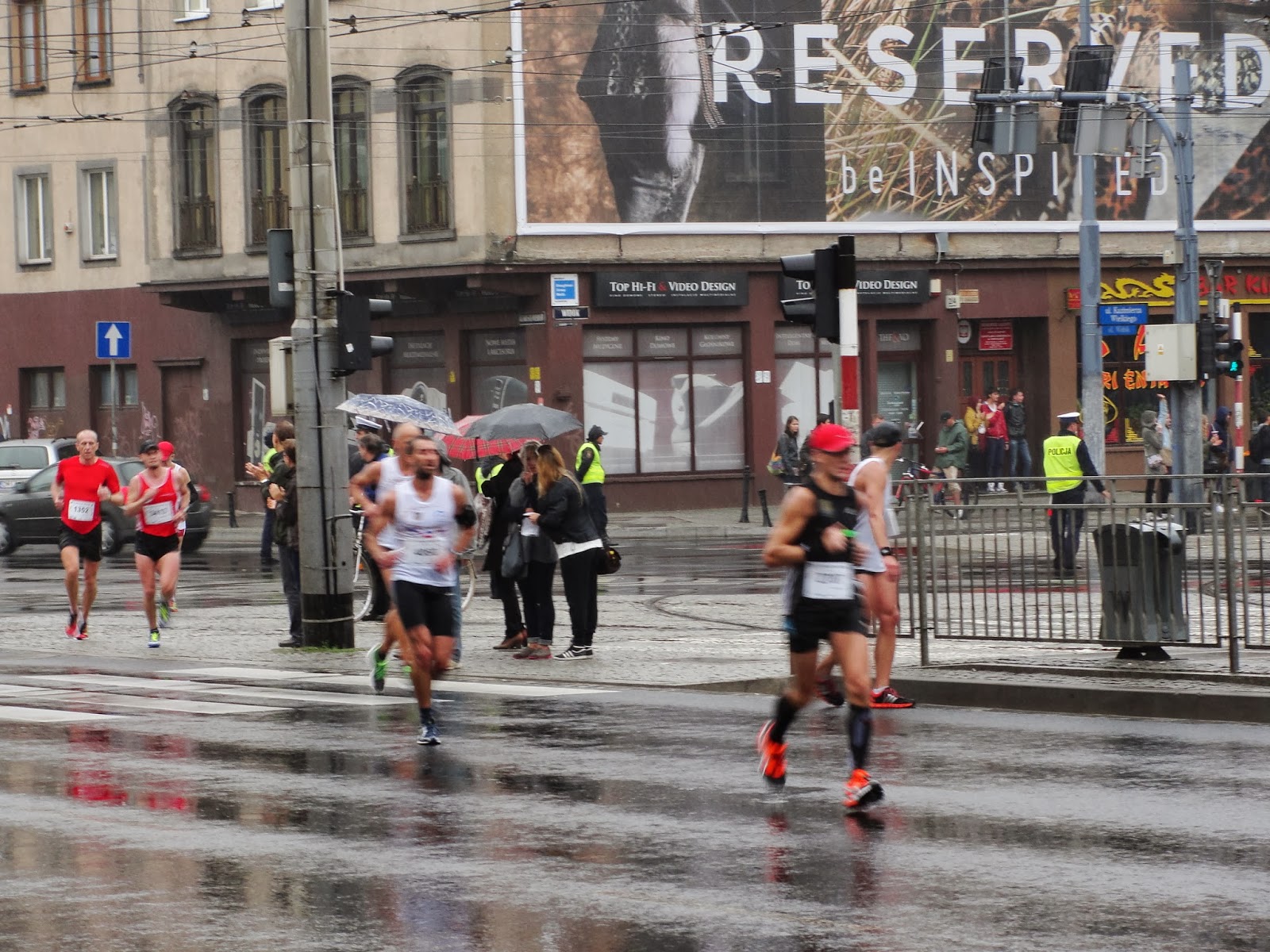
rainy day marathon 
(causing a 2 hour delay for our bus to Prague)

... and the countless youth we saw roaming the streets. All of this is probably why it's a big destination for Europeans looking for cheap beer and a good time on their way to Krakow. But it's so much more than a party town.

Like Warsaw, this city has also been taken over and reclaimed numerous times over the centuries. Given its history of being invaded and conquered by various countries and cultures, now it seems to be a bit of an ethnic and cultural melting pot. For example, our free walking tour guide (love these guys!) pointed out a corner where four religious institutions live harmoniously.

well, at least that's how he described it -
residents will have to confirm

Wroclaw also seemed to be a bit more modern than Warsaw. Vegetarian restaurants and foods were easy to find; the multimedia fountain used that irritatingly catchy Daft Punk song (as well as other equally terrible pop songs) alongside classical music during the water show; even the street art was more art than a political statement.

Honestly, it reminded us a lot of Portland.

Other than the elevator to the top of St John the Baptist's church for a wonderful panoramic view of the city, and the tip for the free walking tour guide, we opted to skip tourist attractions that cost money. We did visit the impressive ethnographic museum (free on Sundays). The exhibits featured centuries-old decorative, cooking and farming artifacts; some details on the area's history over the last 500 years; and an entire floor of life sized dioramas showing typical life back in the day. Really, who doesn't love a good life-sized diorama?!

Otherwise, we just meandered and enjoyed the city. Five Wroclaw experiences that made this our favorite town in Poland, in no particular order:

a Hare Krishna parade down the main square
where no one really seemed to blink an eye at first 
and then lots of the crowd joined in pulling the carriage down the square

walking everywhere - they have a good transit system too 
but the main city is totally walkable top to bottom in a day
(or bike-able if you have short legs) 

speaking of walking, the canal path was really charming 
(and featured the first signs of autumn)

speaking of canals, there are over 100 bridges throughout the city 
even tiny bridges where tiny gnomes light tiny oil lamps

and speaking of gnomes, not gonna lie - 
the gnomes are pretty awesome 
(moreso the original gnomes than ones commissioned by merchants to draw business)

Food notes:

  • great chicken salad lunch at Bela Cafe (no link available, check the CitySpy map though)
  • excellent falafel at Vega
  • instant packages of borscht are actually quite good if you add the right amount of water (and reconstituted soy nuggets and canned peas)

our most random meal yet

Lodging notes:
- Corner Hostel was in a great location but sort of dark and sort of dirty and and very, very noisy


but our room had a balcony with a great view

Definitely a cool town we'd like to visit again. Next stop: a few days in Prague before hitting our vineyard/orchard Help Exchange gig. Charles Bridge and Czech beer, here we come!

If you're going to Białowieża National Park...

In honor of the mountains we finally reached yesterday and the national park we couldn't figure out how to get to in Krakow, here are some tips if you ever plan to visit Białowieża National Park, the oldest forest in Europe and one for the UNESCO World Heritage list.

This probably won't be very interesting for anyone else.  Consider ye warned!

1. As of September 2013, there was one nonstop bus from Warszawa Zachodnia bus station running daily at 1420, arriving at 1930 or so. Other bus and train options ran more frequently but required at least two transfers. It was only our fourth day in Poland and we hadn't even mastered "please" and "thank you" yet, so we opted for the nonstop straightforward approach there.

we made it!

The nonstop bus ended up being about 45zl per person, just 5zl (~$1.60) more than the other options - a good investment.

However, as of September 2013 the nonstop bus from Białowieża back to Warsaw left at some ridiculous time like 0500 and we weren't clear where the starting point was, so we figured it would be easier to wing it on our way back to Warsaw.  We were mostly right - just grab a bus from Białowieża to the Hajnowka train station (see #2), catch a small train to Siedlce (if you just see one car at Hajnowka, that's probably your train), then another train to Warsaw.  Piece of cake.  

Side tip #1: The info center on the main strip in Hajnowka can help you with timetables because there isn't a whole lot of wifi in Białowieża.  They may or may not speak English but they were very nice when we were there; they will print out the schedules and try their best to help you.  There is also a Biedronka and a small street market just a few blocks from the info center if you need groceries for the journey.

Side tip #2: Bring headphones for the ride. The bus to Białowieża goes through tiny villages and the countryside is really lovely, with farm houses lining the roads for kilometers, but the bus driver is likely to be playing horrible American pop music for five hours straight. Richard Marx, Lionel Richie, and Katy Perry until your ears bleed and you want to scream. Yes, headphones are a must!

2. If you stay near the park, do your research on where to get off the bus and how to get the train back to Warsaw. This is definitely not a major transit hub.

And if you don't know where you're going, ask for help - writing things down and pointing confusedly seems to work well, but it was easy for us to find people who spoke English too. Some nice women on the bus helped us find the right stop; we found our room thanks to youth hanging out in the village; on our return trip to Warsaw a man in the village helped us figure out the bus cost; and two older ladies helped us find the train station in Hajnowka (one of them actually walked us five blocks out of her way in the rain to point us in the right direction).

3. Find other English speakers to take the national park tour with you. Because of its preservation status, you can only enter the park with a guide. Polish speakers can get a guide for a handful of zloty, but English guides cost close to 200zl total (yay for "tourist tax"!) - we almost didn't sign up because of the cost but eventually acknowledged that it was probably one if those once-in-a-lifetime things... Four others signed up too, so our $66 tour ended up being $22. (Another pair on the tour was from Oregon - is there no escape from these crazy PNWers?!)

Regardless of the cost, though, the tour is totally worth it. You'll get to see a bazillion species of ancient trees untouched by man for hundreds of years (we saw one tree that fell 30 years ago and was barely decomposing); you'll hear a hundred different species of birds; you'll see a wild boar or two if you're lucky (we saw one!); and you'll pass an unexpected and sobering WWII memorial.

and you'll also see lots of rare fungi

4. If you have planned on cooking your own meals but your room only has a kettle and two small mugs, never fear! There is a grocery store where the road forks just as you come into Białowieża village. It sells all the staples including rice noodles AND it even has dried soy products! This was our first spotting of dried soy and words cannot express how excited I was. Most grocery stores in Portland don't even sell it! Just add hot water and spices, stir, and enjoy.

well... 
perhaps "enjoy" is too strong of a word
how about "it'll do"

5. Wander a bit while you're in Białowieża.  Along with visiting the park, we hiked an entire day along the bike trails to see Miejsce Mocy (an old Slavic "power circle"), beautiful forests, and replicas of old school beekeeping. We spent half a day just wandering around the village and ran into a nice Polish couple at Walizka Cafe who recommended this amazing Lithuanian beer.  (The cafe was pretty awesome, and has free wifi too!)

We also checked out the bison breeding reserve and felt a little guilty doing so - it's goal is admirable and it was awesome to see our bison friends' European counterparts, but the place felt much more like a zoo than a reserve.

Food notes:
  • in addition to the aforementioned rehydrated soy and rice noodles, we enjoyed delicious pulled pork and mushroom soup at Restaruacja Pokusa (the bison-themed beer was pretty tasty too)
  • but that's about it, otherwise we made our own meals
  • and if you do so, you might want to skip the canned meat

Lodging notes:
- Domek Jaskolka was inexpensive, perfectly located, and really charming

and Maria gave us apples from her tree

Białowieża was a lovely break from the city. Many more of those to come, we hope! For now back to Warsaw and then...?

Sunday, October 6, 2013

Warsaw, a month later.

A common question before we left was, "why Poland?"  There are several answers...  Jen had heard stories from friends who visited and fell in love with the country, so it's been on her list for years. Both of us knew some of the history and wanted to learn more from a non-US perspective. In all honesty, we knew we wanted to visit Central Europe and the NYC-Warsaw flight was fairly inexpensive. But it was mostly curiosity that drew us to Poland: how could a country that had been through so much, keep carrying on?

First stop: Warsaw. Warszawa ("var sava"), Poland's capital and largest city, has been taken over again and again throughout history (which we didn't really know), and was almost completely destroyed during WWII (we did know this). Today it's a beautiful maze of historic (reconstructed) buildings, communist-era housing intermixed with new "high scraper" office complexes, and lush, well maintained green spaces.

Over three full days in the city we absorbed as much as possible: the excellent Warsaw Uprising museum, the Jewish cemetery and Jewish ghetto areas, beautiful Park Lazienkowski and Park Ujazdowski near the Royal Route, Saxon Garden where Chopin used to hang out, Park Odkrywcow for fun with sound, the grittier Praga district, and of course the bridges. (We ARE from Portland, after all.)

The highlight was definitely the Warsaw Uprising museum. Weaving our way through hundreds of relics from, and stories about, almost 60 days in the fall of 1944 when thousands of Poles rose up against the Nazi regime in an attempt to reclaim their city... How did our US history classes gloss over this? Making weapons from scraps, eeking out food rations for the army, hiking through sewers - this was the resolve about which we had been so curious. Even Ronald Reagan acknowledged the importance of this movement on its 40th anniversary (possibly the first and only time we have ever agreed with him).

Walking around downtown, it's difficult to forget the city's recent history - monuments to the Warsaw Uprising and various other WWII mementos are everywhere. Yet it's almost impossible to believe that the war was just 65 years ago. Aside from what may be bullet holes on tombstones in the Jewish cemetery, there's not much evidence that 85 percent of the city was demolished. At least, not to our eyes.

It's easier to see that communism ended almost 25 years ago. Rows and rows of square housing units still stand but have been painted bright colors. Billboards and shiny "high -scrapers" have taken over the main streets but drab buildings still stand in their shadows. You definitely get a different vibe from the older and younger generations.

But the younger generations seem to have that same resolve. One afternoon we watched a growing group of protesters seeking fair pay for justice workers. Large, detailed political murals grace buildings all over town. Polish pride practically dripped off our young guide during the Old Town walking tour. And Poland's governmental actions over the past 20 years have generally been commendable.

As an aside, we'd read that Central Europeans were somewhat standoffish; for the most part, the Varsavians we encountered were very friendly. We tried to learn the basic essential phrases (hello, please, thank you, excuse me) which may have helped. One older gentleman working at the tram station went out of his way to help us purchase a ticket and we almost stopped by on the way home to thank him again (and show him that we made it to and from our destination successfully). We even had a lively but incomprehensible conversation with an older woman at her fruit stand one evening - after she learned that we spoke English, she continued to talk to us in Polish for several minutes. (Something about the UK... and pink... we think??) Nothing to do in that situation other than nod, smile, laugh, and buy some of her delicious fruit!

Speaking of food...

  • Patrick tried pierogis (while jet lagged, more experimentation is definitely required) 
  • we both sampled delicious breads and pastries from local bakeries and fruit from street stands (news flash: Jen can eat a lot of the Central European bread!) 
  • kebabs! the falafel from El Karnak Bar was awesome 
  • kielbasas from the local supermarket were delicious in our hostel pasta, too
  • and the free vodka shot and lard sandwiches during the walking tour was a nice touch

Lodging notes: Hostel Tamka.  It was aight.

Everyone touts Krakow as Poland's gem,  and we have no doubt that we will love that city, but we're glad Warsaw was our intro to this beautiful country.  Out of curiosity a while back, we'd asked friends what came to mind when they heard "Warsaw" and all the answers evoked a somber mood.  Our walking tour guide asked a similar question before starting our tour; several people responded with answers including the words "gray," "worn," "cold".  There were definitely somber undertones everywhere we went, even if it was just us chastising ourselves for complaining about being tired or hungry (you think YOU'RE tired and hungry?) but the brightness of the city even on overcast days overwrote the undertones.  If that makes any sense.

yep - resolve

Next stop: Bialowieza National Forest for a little R&R... in a primeval forest with free roaming European bison. This adventure just keeps getting better.

Friday, October 4, 2013

Harvest time WWOOFing in the Czech Republic.

We reached out to our sixth farm host, a vintner in Nemcicky (Southern Moravia) named Richard, while we were in Wroclaw. As previously mentioned we were a bit tired of city-hopping and eager to get back to the outdoors, manual labor, good company and cultural exposure, and someone else telling us what to do for a little while instead of having to figure it out ourselves.

Our research indicated that Richard was quite progressive - in addition to traditionally hand-crafting wine, he also started the area's local slow food movement. We were excited to learn his methods and hear his perspective on food, politics and Czech life in general.

We arrived later than expected that first night but Richard, his wife Stania, and their children Ziva (6) and Teo (4), warmly welcomed us into their home. It would be the first of many pleasant hours spent in their cozy kitchen enjoying Stania's delicious meals and Richard's tasty wines while we talked about Czech life, helped Ziva take care of her stuffed animal babies, and listened to Teo's lively stories and songs. (We didn't understand a word he said but his facial expressions during storytelling were absolutely priceless.)

where's Teo?

Our work on the farm varied daily but centered around the harvest. Days were long, often 10 hours, so the work was physically tiring but not difficult. We arrived just in time to...

... collect walnuts from the orchard

(with a little help from their 13 sweet goats)


... harvest apples


... pick hundreds of plums for
drying and making jam and brandy


... gather hay for composting
(with the help of an antique hay sweeper)


... and relocate other hay for winter feeding
(the smell of hay + crisp, clear weather = autumn nostalgia!)


... harvest grapes

... and of course - stomp grapes!

Richard's methods are traditional, meaning he uses no modern machinery other than a car and a tractor. His antique tools and hand- harvesting bring an authentic quality to everything his family produces. Take his wine, for example:

grapes are hand-clipped


then passed through a hand-cranked grinder
(in a 300 year-old wine cellar)


then stomped by foot


and finally, meticulously strained, pressed, aged accordingly, and bottled by hand

The end product is (pardon our lack of wine terminology) clean, crisp, and delicious!

Authentic extends to the family's wholesome approach to food as well - Stania's cooking definitely left a mark on us. Meals are prepared fresh daily, generally from the garden. Bread is baked from scratch and goat cheese is made by hand, with love. Harvested berries and fruits are dried and turned into snacks, teas, jams, and delicious desserts (made with hand-ground flour). We look forward to trying some of her techniques when we have a garden (and kitchen!) of our own.

fresh picked pumpkins for lunchtime soup
(ingredients: pumpkin)

homemade goat cheese


amazing plum crumbles that 
magically appeared every day

"Authentic" translates to "high quality" but also "takes lots of time", and we were glad to help the family out during this busy season.  We did get some down time too.  There are tons of hiking and biking trails in and near Nemcicky; wine bike tours often go through town. One of our days off was spent hiking to Boleradice to explore the village and check out the watchtower - one of many slightly controversial EU projects endorsed by the local mayor.  The views of the vineyards and fields of sunflowers along our walk made the 15km leisurely day completely worthwhile.

Boleradice village

all along the watchtower

On another day off we went with our hosts to a neighboring village, Mikulov, right near the Austrian border.  There was a cheese fest (!), a lovely square, an old castle busy with weddings, beautiful weather, delicious dumplings and great lunchtime company...  Can't really ask for much more.

no one in the world knows where we are right now -
including us

As far as life in Nemcicky, from our "outsider-two-week" perspective... The 600-person village itself is charming, especially with the houses already decorated for Halloween and the neighborhood children who shout "dobry den!" ("good day!") to everyone as they run to catch the bus.  The lush green fields are incredibly soothing and the sunrises and sunsets are stunning.  The village PA system blaring news twice daily is even sort of charming, albeit reminiscent of the communist era (or The Others' village from Lost).

But unlike our farm stays in Canada, everyone locks their cars and homes.  Generally speaking, there's not a lot of smiling or waving as you pass people on the street.  It wasn't uncommon to find things missing - from a handful of walnuts to entire trees!  "Gypsies" roam the neighborhoods and occasionally take over the village loudspeaker selling or trying to buy things...  So, no different than most towns in the world.  Don't misunderstand - we always felt safe, it just seemed a little lacking in the "community" sense.

We loved Nemcicky and enjoyed our stay very much, and we wish the best for this wonderful family.  And now it's back to city hopping while we research our next Help Exchange opportunity.  Dekuji, Staveks!  We hope to visit you again - next time, in the spring!


parting gifts from our hosts