Showing posts sorted by relevance for query sapa. Sort by date Show all posts

Thursday, April 17, 2014

Slowing down to volunteer at Sapa Hope Center.

For the past week we've been volunteering at Sapa Hope Center, a non-profit project aiming to provide shelter for homeless mountain children from surrounding villages and free English lessons to anyone in the local community. About 20 homeless children currently rely on support from their extended families and their local community; there is no government assistance for this demographic. Sapa Hope Center will help to ease the community burden and offer these children a brighter future.

the vision

Sapa Hope Center was founded by a philosophical entrepreneur named Peter Thuong. While living in Hanoi about ten years ago, Peter visited Sapa and was moved by the stories of the mountain children who walked many miles each day to sell trinkets and handicrafts to Sapa tourists in order to support their families. He learned that some children had lost parents due to illness or injury in the field. Peter was inspired to help, so in 2011 he opened Sapa Backpackers, a hostel/coffee shop whose profits would fund construction and maintenance of Sapa Hope Center.

the present state

In 2014 land for Sapa Hope Center was purchased and building began. In true grassroots form, locals from the ethnic villages have been helping with construction; volunteers do the rest. Tasks over the past week have included painting colorful and educational murals...

dinosaur dorm - the beginning

dinosaur dorm - the middle

dinosaur dorm - complete!

... sealing walls with cement in prep for painting...

Patrick and Harry supervise Tim

... and cleaning and preparing the Center and grounds for their first use.

cleaning and sorting dishes

project kitchen organization: complete!

garden cleanup

Peter hopes to have the Center open for business by June 2014 - pretty ambitious. To help reach this goal, Sapa Backpackers offers guests inexpensive lodging or food in exchange for volunteering their time at the Center. Guests are also encouraged to teach English lessons at the new Center or in the evenings at the hostel.

free English lessons for local children

snack break

Peter's vision for Sapa Hope Center is inspiring. A stable home means healthier and safer children. Free English lessons open up educational opportunities in the booming local tourism business - or whatever industry these children wish to enter. And his international spin on the lessons means that the children will have a well-rounded education. Peter wants to see a zoo painted on the outside wall with animals from all over the world; another wall will feature a world map with flags of each country; and international volunteers are welcomed at the Center. During our stay we worked alongside travelers from England, Germany, Canada, Switzerland, and Australia.

map-sterpiece in progress by Hagen and Josh

And Peter's commitment to his mission is impressive. Day in, day out he runs the hostel (including transport and tour organization, which is probably a full time job in itself), manages volunteers at the Center, and keeps his vision moving forward. His methods are meticulous and methodical whether he is moving a pile of cinderblocks, scraping paint from a sink, or teaching the children vocabulary. Yet he always has time for a thoughtful conversation.

The walk to Sapa Hope Center from Sapa Backpackers is 5km each way. It takes about an hour going and a little longer coming back, mostly because the return trip is uphill but also because the group tends to stop for a beer or three after their hard days' work.

not kidding - it really is 5km each way

and it really is uphill on the way back

but the views are lovely

The exercise and scenery were nice, but I like to think that there is also some symbolism in having the volunteers walk 10km each day. The kids from the mountain probably have a much longer daily walk just to bring home a few dollars for their families...

We have to move on soon but we are glad we could help out in a small way this past week. We wish the best for Peter, the kids, the new volunteers, and Sapa Hope Center!

Sunday, April 27, 2014

Scratching Sapa's shiny surface.

Most travelers roll into Sapa early one morning, check out local sights for a day, then do an overnight trek and/or rent a motorbike to explore and/or hike Phan Xi Păng (the tallest mountain in Vietnam), and then they roll back out again. Dozens of overnight tours run from Hanoi to Sapa each day and it's a popular stop before crossing into Laos or China, or when entering Vietnam from those countries.

We had the luxury of staying for about 10 days with plenty of time to just sit and absorb our surroundings.

the lake downtown

the chicken stands at the market
(Patrick hated walking through here,
especially on the way to breakfast)

the church lit in neon at night
where everyone takes a picture
(we're still not sure why)

the vegetable stands outside the market

sunsets at the lake

This beautiful mountain resort town is located high in the Hoàng Liên Son range of mountains near four ethnic villages. (Or five, or eight, depending on who you ask.) The villages rank as some of the poorest in Vietnam.

As with other areas in the country, the women of the family go into the city to earn money while the men tend the fields. In places like Saigon and Hanoi this means women walk the streets for hours selling fruits or vegetables, flowers, sunglasses, Lonely Planet tour books... In many cases they start before dawn and don't stop until their baskets are empty - or nightfall, whichever comes first. Many of these women sleep in shared rooms and don't see their families for weeks at a time.

In Sapa, the women come to town from their ethnic villages, often with baby (or babies) in tow and always dressed head to toe in beautiful traditional clothing, to sell handicrafts and trekking tours. Although plenty of Vietnamese folks vacation in Sapa, the village women seem to primarily target foreign tourists. From the moment you step off the bus to the moment you leave, village women approach you to ask the same questions over and over again: "where you from? what's your name? you go trekking? you shopping?" No, thank you.

Children from the villages also wander the streets selling trinkets to tourists - a highly discouraged practice. These kids who should be in school walk miles to town and back each day to ask the same questions: "where you from? what's your name? you shopping?" No, thank you.

(And just when you think your patience has recovered from these barrages, the motorbike guys start in: "hello! motorbike!" "you want motorbike?" "yo! motorbike!" No, thank you.)

Sitting for 10 days we noticed an interesting avoidance between the ethnic folks and the Vietnamese tourists. The latter show up in fancy business clothes and stiletto heels; drop hundreds of dong on dinners, rice wine, and fancy hotels; mercilessly snap photos of ethnic folks in town; and don't seem to do much trekking to see where and how the ethnic folks live.

we benefited from tourist rice wine one night
simply by sitting at the next table

they offered us shots, videotaped it
and took pictures of us and with us

it was amusing, yet
awkward and weird

The villagers seem to view the Vietnamese tourists as "wealthy". It's true that excess money may be one definition of "wealth", and without going down a westernized privileged rabbit hole rant about how excess money can't buy happiness we'll say that it does enable food on the table, a roof over a family's head, and less hard work in the fields. There's also a TON of history between the groups and some complicated politics that we haven't even begun to comb through and will never fully understand... But we couldn't help but notice the obvious disdain (or was it envy?) directed at tourist women with Gucci purses wearing five-inch heels teetering down cobblestone streets. (To be fair, the local Vietnamese women may have had the same reactions to these tourists and we just didn't see their faces.)

Villagers marry young and many families have several kids by the time the parents are 20 years old. The pre-teen girls at our hostel rolled their eyes and tsk-tsk'd at us when they found out that we weren't married and had no children. Luckily, Patrick got an eye infection and we distracted them from commenting on our living in sin by telling them stories of how I punched him in the eye because he wouldn't buy me [flowers/bananas/jewelry] from the market. "You go buy your girlfriend flowers!", they would tease every time they saw us. We liked those girls a lot.

goofy Gia and silly Sang

sweet Son Mai

We did get out of our little backpacker/market bubble now and then too. Sapa is a shopper's dream - you just can't escape it. One day we visited nearby Cat Cat Village where the big draws were handmade clothing and cold drinks. Instead of shopping we kept to ourselves and visited the waterfall and a nice stream side trail.

the falls before the falls

appropriately named Cat Cat waterfall

"you shall not pass!!"

almost empty trail

with a few guest appearances

We skipped the Phan Xi Păng climb, we didn't rent a motorbike and run wild through the foggy mountain roads, and we declined an invite to a village wedding since we didn't know the bride, the groom, or anyone remotely involved with the wedding and felt it would be intrusive. But we did sign up for an overnight trek/home stay at a local village. Basically, you go with a villager who speaks some amount of English and can explain the terrain, the plants, the villages, a little history. We trekked about 15km the first day and about 10km the second, and slept in a loft at a local villager's home the first night.

the mountains were beautiful even with the haze

and the terraced fields were stunning

Our homestay was a modest but comfortable wooden house in the middle of a farming village. It was home to a three-generation family of about 10 (people kept coming and going, it was hard to tell who lived there and who was just visiting). They welcomed us warmly but otherwise went about their usual activities, leaving us to observe.

the kitchen

the stove

the lunch spread

the village kids
(they loved seeing their photos on the camera)

the village ladies

the morning view

the guard dog

In our eyes their lack of material wealth was more than compensated by their hearty meals, their lively conversations, and the loving way they treated their kids. I doubt they would see it that way, but that's how we saw it.

As with any place, the longer we stayed in Sapa the more the glitter wore off and true colors started to show.

In Cat Cat Village kids were everywhere; most waved or said "hello" but one little boy hit me on the leg for not giving him candy. (We don't do that, ever.)

One afternoon while we were lunching at the market a village man who was either drunk, mentally ill, or both sat right next to me and continued to rant loudly while manically waving his arms around. (We moved to an empty table - there were tons of empty tables so why he had to sit right next to me is still a mystery.)

The wholesome, authentic appearances of the ethnic villagers started to wear away as we saw them eating packaged ice cream cones and drinking Red Bull around town. (Like Happy Meals and Slurpees in America, these things were easy to find and fairly cheap. But look where Happy Meals and Slurpees have gotten America...  And yet as I'm writing this, I've just finished half a pack of Ritz cheese-filled crackers and a sugary soy milk - so who am I to say anything at all?)

And eventually we learned that the five villages don't really talk to each other. (The tribal languages are different so that kind of makes sense, but enough people in the villages know enough English to lead treks and one would think they might try to work together as a united community instead of competing for tourist dollars. But there goes that pesky western perspective again.)

As with most of our other visits, ten days was probably just the right amount of time - we were ready to move on but a bit melancholy about leaving.  We liked Sapa.

Food notes:
  • Sapa's downtown is all overpriced tourist cafes, bars, and "handicraft" and imitation North Face shops.
such as this bar
where we celebrated one year of FUNemployment
    We generally avoided the madness and spent most of our food budget at the market. We tried a few different stalls and ended up eating at the same stall so often that the older woman who prepared our meals slowly and with such care would smile when she saw us coming; she even added extra meat to our dishes near the end of our trip.
not pictured: nice lady

bun cha is the new pho ga

our daily habit
  • We paid too much for fresh fruit and street food, but since we got a lot of free dinners from our volunteer gig we didn't care too much.
pork buns with quail eggs, $0.50 each -
cheap by American standards but...

street bbq made while you wait
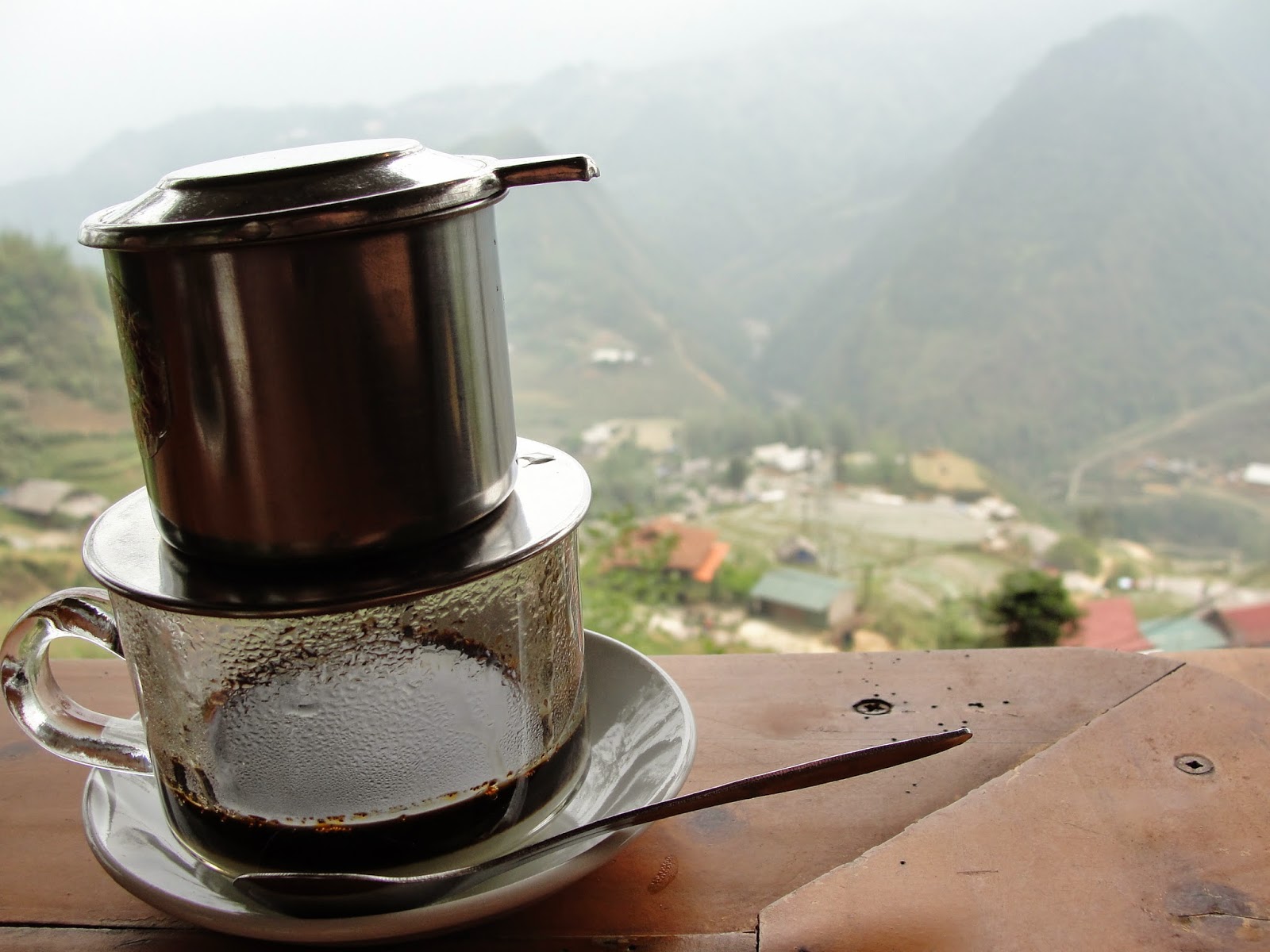
  • And we drank a lot of delicious coffee.
of course

Lodging notes: Sapa Backpackers was one of those "you get what you pay for" places. It wasn't the cleanest or most comfortable hostel we've stayed at but for $3/person/night, with all profits going into Sapa Hope Center instead of general hostel upkeep, we certainly couldn't complain.

We got really used to our Sapa routine of breakfast and volunteering, and a lot of goofing around with the pre-teen girls at the hostel every day.

Gia was the photographer of the group

we have many more shots like this

A friend predicted that Sapa would be our favorite part of the country. So far she's right, but a big part of it is due to our volunteer experience and interaction with the local kids. We continue to struggle with this whole tourism thing and its impact on the local communities, though. There's a lot of gray and there doesn't seem to be a good answer. I guess we'll just keep doing what we feel is right and see what happens...

Tuesday, May 20, 2014

Vietnam on $30/person/day.

We thought Vietnam might be a little more inexpensive than it was, but there aren't really many hostels (and honestly, we're kinda done with hostels anyway) and hotels don't really let you cook in their kitchens (but who wants to do that when a great meal costs as little as $1?).

Tours and flying vs ground transport will run you a little higher but generally speaking, we ate well, we slept well and we had a really good time for an average of $30/person/day.

We're basing the Year Two plan on our expenses in Vietnam (assuming the same $30/person/day average will apply in Lao, Thailand and Cambodia). If you take out our flights into Vietnam the average is more like $22/person/day, and we'll most likely be traveling by bus into the other countries. So hopefully we're erring on the cautious side.

Anyway! Here's the breakdown with some details...

Initial budget: we really had no idea what to expect, but estimated no more than $30/person/day
Actual cost: 59 days at $3569 ($60/day, $30/person/day - sweet!)

pie chart skills continue to decline

  • Lodging: $661 - 56 nights at guest houses or 1-/2-star hotels averaging $6/person/night (3 overnight buses/trains not included here)
  • Transportation: $1649 - the biggest expenses here were our flights from Madrid-Ho Chi Minh City ($923) and Hanoi-Ho Chi Minh City ($174); otherwise this accounts for trains/buses between major cities, obligatory taxis from Danang-Hoi An and Dong Hoi-Phong Nha, a couple ferry rides and motorbike rentals, and nominal dollars spent on public transportation everywhere
  • Groceries: $154 - we never cooked our own meals other than ramen, so this is mostly for gallons and gallons of bottled water and snacks during transport
  • Meals: $500 - again, we ate out almost every meal so this comes to roughly $4.25/person/day (yes, this includes lots of free breakfasts at hotels, but still - per DAY)
  • Tours: $229 - various museums in Ho Chi Minh City, Buôn Ma Thuột and Hanoi; admission to parks or other local attractions in Dalat, Buôn Ma Thuột, Quy Nhơn, Phong Nha, Sapa and Cat Ba Island; organized tours to the Mekong Delta and My Son Sanctuary; trekking in Sapa ($25pp) and kayaking near Cat Ba Island ($16pp)
  • Alcohol: $52 - beer is about $0.50 so you do the math
  • "Misc": $42 - $9 in laundry; $9 for our "entertainment" splurges of the water puppet show and paddle boats in Hanoi; $24 for two months of random expenses including Jen's t-shirt, souvenirs in Sapa, Jen's haircut, a gift to our super-nice hotel owners in Dalat, a book in Hanoi, and some other trivial things
  • Border: $282 - $140 each for our 3-month visas, plus $2 in "exit" fees when we crossed into Lao

Other fun Vietnam facts...
  • Cities visited: 13 (Ho Chi Minh City, Can Tho, Dalat, Buôn Ma Thuột, Nha Trang, Quy Nhơn, Hoi An, Phong Nha, Hue, Hanoi, Sapa, Halong Bay, Cat Ba Island)
  • Bowls of pho consumed: we can't count that high
  • National parks visited: 2 (Cat Ba, Phong Nha-Ke Bang - we also got really close to Bidoup Núi Bà near Dalat)
  • UNESCO World Heritage Sites visited: 4 (Hoi An Ancient Town, My Son Sanctuary, Halong Bay, Phong Nha-Ke Bang)
  • Plastic water bottles thrown away: we don't want to know

Fellow travelers, what was your experience with costs in Vietnam?  How did you save money - and what did you splurge on?

And now to Lao, where 8000 kip is roughly $1! Just when we'd gotten used to the 21,000 dong/$1 conversion... Travel is hard!

Friday, August 29, 2014

Friday five: things we will miss about SE Asia.

As we enter this whole new world of Nepal for a month and start to make amazing new memories, we wanted to pause and mention a few random things we will miss about SE Asia. In no particular order, they include...

The ancient history. These cultures have intermingled, fought together against outside enemies and also against each other, and influenced each other since what seems like the beginning of time. As a result, architecture and religion came together in some really amazing ways over the centuries.

Cham Towers near Quy Nhon, Vietnam

Phra That stupa in Vientiane, Lao

Buddha statues in Si Satchanalai, Thailand

the story on the wall at Angkor Wat, Cambodia

And like the countries in South America, each SE Asian country we visited claims to have the oldest "this" or the most precious "that", and everyone claims that they ruled the whole territory back in the day. The perspectives were fascinating.

The markets. Not the shopping markets - but if you've been reading you know that already. We're talking about the fruit and vegetable markets that are usually surrounded by food stalls.

Hoi An, Vietnam's lunch market

Sapa, Vietnam's veggie market

Kampong Cham, Cambodia's fruit market

Phnom Penh, Cambodia's Russian market

We loved the fruit markets in Central Europe and we loved the addition of food vendors in SE Asia.

The critters. We spent a lot of time outside over the last six months, so we saw some pretty amazing critters. Butterflies of all shapes and colors, giant spiders, patient snails and grasshoppers, tiny geckos...

... lizards large and small...

... crazy jungle bugs...

... urban snakes...

... and one scorpion hung by its tail in Nong Khiaw
(yep, it was still alive)

The jungle bugs were the best. (They always are.)

The lush green even in the midst of otherwise dry, dusty villages.

terraced rice fields in Sapa, Vietnam

our backyard in Viang Veng, Lao

hiking in Koh Tao, Thailand

view from Kep National Park, Cambodia

The natural beauty in each country was really stunning.

And of course, the warm, friendly people and the kids screaming "HELLO!" everywhere we went.

Gia, SuSu, and Sang from Sapa, Vietnam

cute Misato at our Thailand farmstay

Mr Cherin from ThreeJ Guesthouse in Kamphaeng Phet, Thailand

our HFH Cambodian team leader Samvitey ("Raymond") from Phnom Penh

We especially appreciated the warm welcomes in the non-touristy towns and villages like Buon Ma Thuot, Quy Nhon, Oudomxai and Kamphaeng Phet. (And all of Cambodia.)

With the yen comes the yang, so here are five things we won't necessarily miss about SE Asia, in no particular order...

The hot. OMG THE HOT. It was no dry heat either - it was all humidity all the time. From March through August, temperatures ranged between 30-40C (that's about 85-105 for you US folks); add 80-100% humidity and you get OMG THE HOT. Didn't stop us from spending lots of time outside...

Dalat, Vietnam
(March 2014)

Cat Ba Island, Vietnam
(April 2014)

Nong Khiaw, Lao
(May 2014)

And that's about the time we stopped taking pictures of us sweating like pigs. But it went on through the end of Cambodia, and we never did acclimate to it - our last day in Bangkok, we ate lunch at an outside market and dripped with sweat the whole time.

The noodle soup. It can be quite tasty sometimes, and also quite photogenic, but more often than not it's quite plain and certain nutrients are consistently lacking.

our first noodle soup
Ho Chi Minh City, Vietnam - March 2014

we ate a lot of these too
(gotta do what you gotta do sometimes)

our last noodle soup
Bangkok, Thailand - August 2014

I'm pretty sure our bodies suffered from all the noodle soup. We had to work really hard to balance our vitamin intake, and even still this usually meant juices from the grocery store which were usually heavy on the sugar. Even milk has lots of sugar here. Really looking forward to a sugar detox soon.

The long bus rides. They were never actually comfortable, and the levels of "uncomfort" varied from A/C sleepers with hard short beds, to A/C buses with narrow seats and no leg room, to buses with no A/C and incredibly hard seats.

our first "sleeper" bus to Dalat, Vietnam

oscillating ceiling fans, one of the greatest inventions

Buses were often loud, one way or another. Many had TVs which blared atrocities like karaoke videos or Jackie Chan movies. And almost every bus had a horn and a driver who wasn't afraid to use it - nonstop. Thailand was the only country where horns were a rarity. As a result the rides could be pretty stressful at times.

border crossing bus rides were always stressful
no matter how many times we did them

But the scenery along the way and the amazing bus decorations usually made up for all the "uncomfort."

Clarence enjoying a little buddy time on the bus to Battambang, Cambodia

The plumbing. We had no problems adjusting to the showers-with-no-bathtub and occasional squat toilets.

What killed us were the bathroom sinks with detached plumbing underneath. Brushing your teeth or hand-washing laundry became an exercise in keeping your feet dry because the sink drained directly into the floor. Sometimes there was the illusion of plumbing but sometimes they didn't even bother.

the pipe to nowhere -
Shang Hai Guesthouse in Battambang, Cambodia

Sometimes there was a makeshift drainpipe that hung over the balcony. Those were our favorites.

The rented bicycles.  Apparently it's a rule in SE Asia that bicycles for rent must have half-pumped tires, no gears or malfunctioning gears, and short seats that make your knees ache with every pedal rotation. We still managed to have fun on these bikes...

our first bike rental in Hoi An, Vietnam

not even thinking about climbing that mountain in Nong Khiaw, Lao

goofing in Sukhothai, Thailand

fun with signs in Si Satchanalai, Thailand

... and we've vowed that any bike we purchase when we get back to the US will have these exact specifications.

So that's our SE Asia wrap. The amazing definitely outweighed the mildly annoying, and we were usually able to laugh through the mildly annoying anyway.

If you've been to any of these SE Asian countries, leave us a comment with something you miss (or don't miss). We'd love to compare notes!