Saturday, February 21, 2015

Southernmost WWOOFing in the USA (a salute to Earth Matters farm).

Seed, plant, weed, harvest - the life of a farmer.

Okay, maybe there's a little more to it than that.

Okay, maybe there's a whole lot more to it than that. But after spending decades in the fields of Southern California, Mexico and now Hawaii, Greg Smith has this farming thing down to a science.

Some might say it's a mad science - at Greg's farm you'll find no garden maps, no written schedules of what was planted when, no documentation on how the last crop fared, no popsicle sticks in the seed trays or garden rows indicating what was planted, no permaculture books on site, no xeroxed copies of what vegetables complement other vegetables...

no idea what's in those trays
(but the farmer knows!)

All of this may not be written down but it's definitely all in Greg's head. His hearty 3-acre garden supports a 30-member-and-growing CSA as well as a weekly farmer's market... and his mad scientist approach totally works!

Welcome to South Point, where everything is the "southernmost" in the USA: the southernmost bakery, the southernmost point to jump in the ocean, the southernmost city signpost, the southernmost restaurant, and of course the southernmost organic veggie farm:

also known as
our first WWOOF gig in Hawaii

At Earth Matters Farm, just about any vegetable (and even some fruits) thrive year-round. Greg has just three hardfast rules for the farm: never use chemical sprays, don't immediately replant the same veggies in the bed you've just cleared, and always add calcium before you plant a new crop. Anything else is pretty flexible.

We spent almost 6 weeks at Earth Matters and we loved every minute. Each day was basically the same - and I definitely don't mean this in a bad way.

we seeded

we planted

we weeded
("are we there yet?" "just a little further...")

we harvested

Like any farm, every day was the same and yet every day was different. We might show up on Monday to a mess from a windstorm, or a full-on chicken hunt after finding decimated cucumbers.

gale force winds the day before we arrived

"where's my gun?!"

Tuesdays might find us harvesting carrots, or squash, or eggplant, or celery, or fennel, or turnips, or broccoli, or beans, or bok choy, or any mix of the myriad of greens in Greg's garden... and sometimes all of that... for the CSA boxes.

boxes o'plenty

beautiful turnips

sweet carrots

squash bounty

Wednesdays one or both of us worked at the Ho'oulu Community Farmers Market, where the produce for sale changed weekly.


service with a smile

Thursdays and Fridays at the farm were usually pretty chill. Sometimes we worked on small farm maintenance projects, sometimes we had seeding or planting or weeding or harvesting projects.

operation banana plant relocation 2015

the winter '15 turmeric harvest

Thursdays and Fridays also usually involved a lot of quality time with Pumpkin and Pineapple, the southernmost cutest farm cats in the USA.

"helping"

"double helping"

We loved the peace and quiet at the farm. We loved the weekly routine. We enjoyed the company of our fellow WWOOFers and all the other regulars at the farm. On most days, Greg would point out a few projects in the morning and we'd all get to work. If we finished our projects we'd find something else to do - there's always something to do on a farm...

... like teach Pumpkin bad habits

... or snuggle with Pineapple

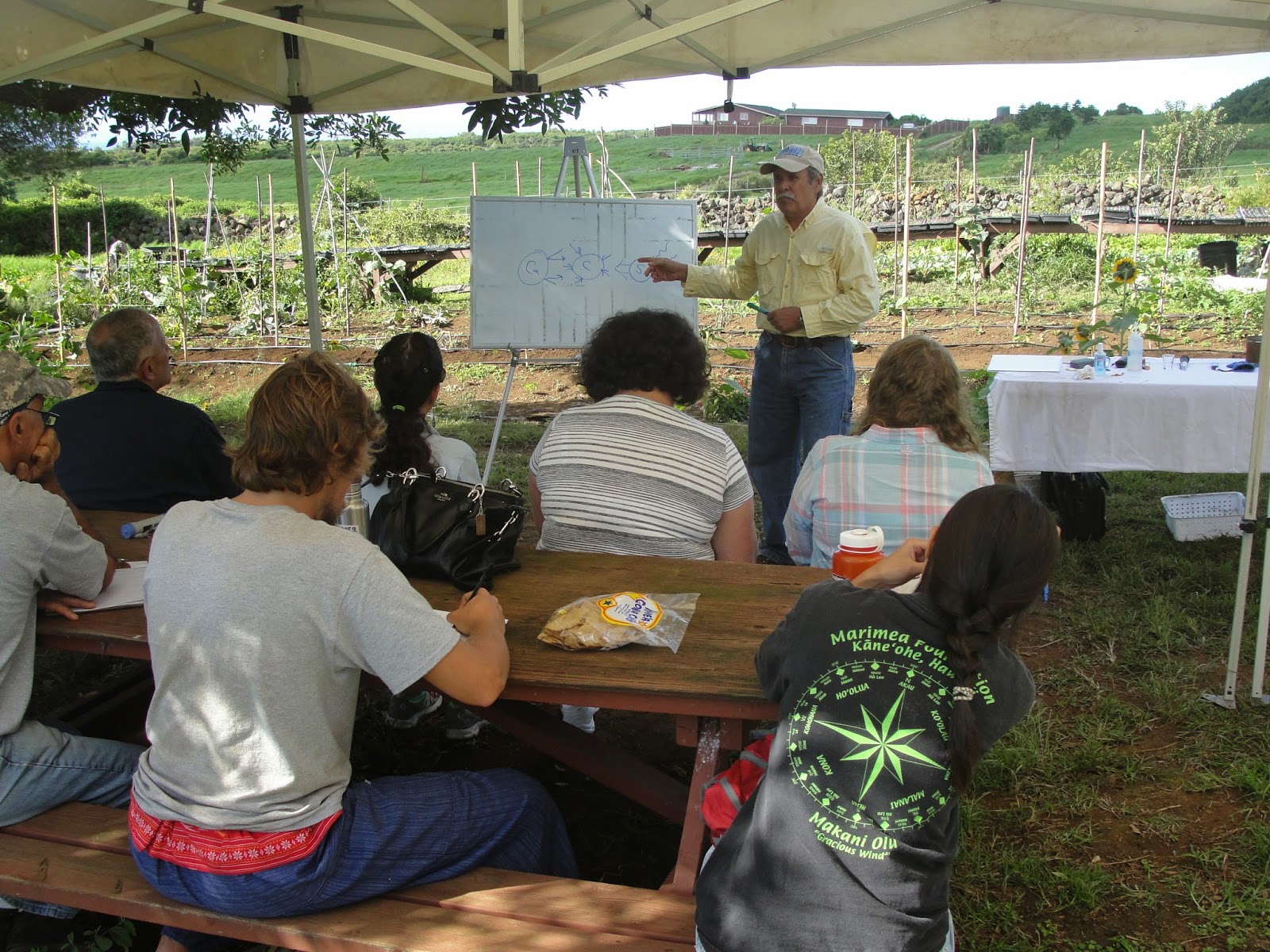
Twice during our stay Greg hosted workshops for a local nonprofit at the farm, and another time he held a two-part soil class for local gardeners. In exchange for a little help putting lunch together, we were able to attend the soil class and learned heaps about fermentation as fertilizer, soil composition, and how to balance nutrients in the soil for optimum plant growth.

machete + banana flower + sugar + time
= fertilizer

soil class: like high school science class,
only relevant and fun

Once in a while we did yard work around the WWOOFer accommodations. We stayed in the lower flat of a vacation rental that helps supplement the farm and WWOOFers. Our flat was spacious and well-equipped and the gardens around the house were just stunning, especially after we spent several days weeding and cleaning up the yard to let the beautiful tropical plants breathe.

before

after

a rainy yard work day
is still better than Monday in a cube

It wasn't all work though - if you can really call this "work." We got down to South Point a few times after "work" and we also did some local hikes.

Patrick, the southernmost jumper in the USA at that moment

some of the southernmost lava rock trails at Manuka State Park

Kahuku's beautiful Kona Trail
featuring the southernmost oldest hardwood trees on earth

Oh yeah, and Jen turned 40 during her stay.

southernmost birthday celebration
(with WWOOFer Alex)

Greg encouraged us to explore but honestly, DAY 650. We were happy to just sit on the porch after work and watch the sun go down and the moon come up between the trees.

6:36pm

6:58pm, one week later

We were also happy to eat delicious food from the farm and the backyard.

best carrots EVAH
(it helps when one of your WWOOF roomies is a chef)

eat five colors a day, kids!

NOM

looks just like my Pearl Jam t-shirt

fresh from the backyard

fresh from the ocean

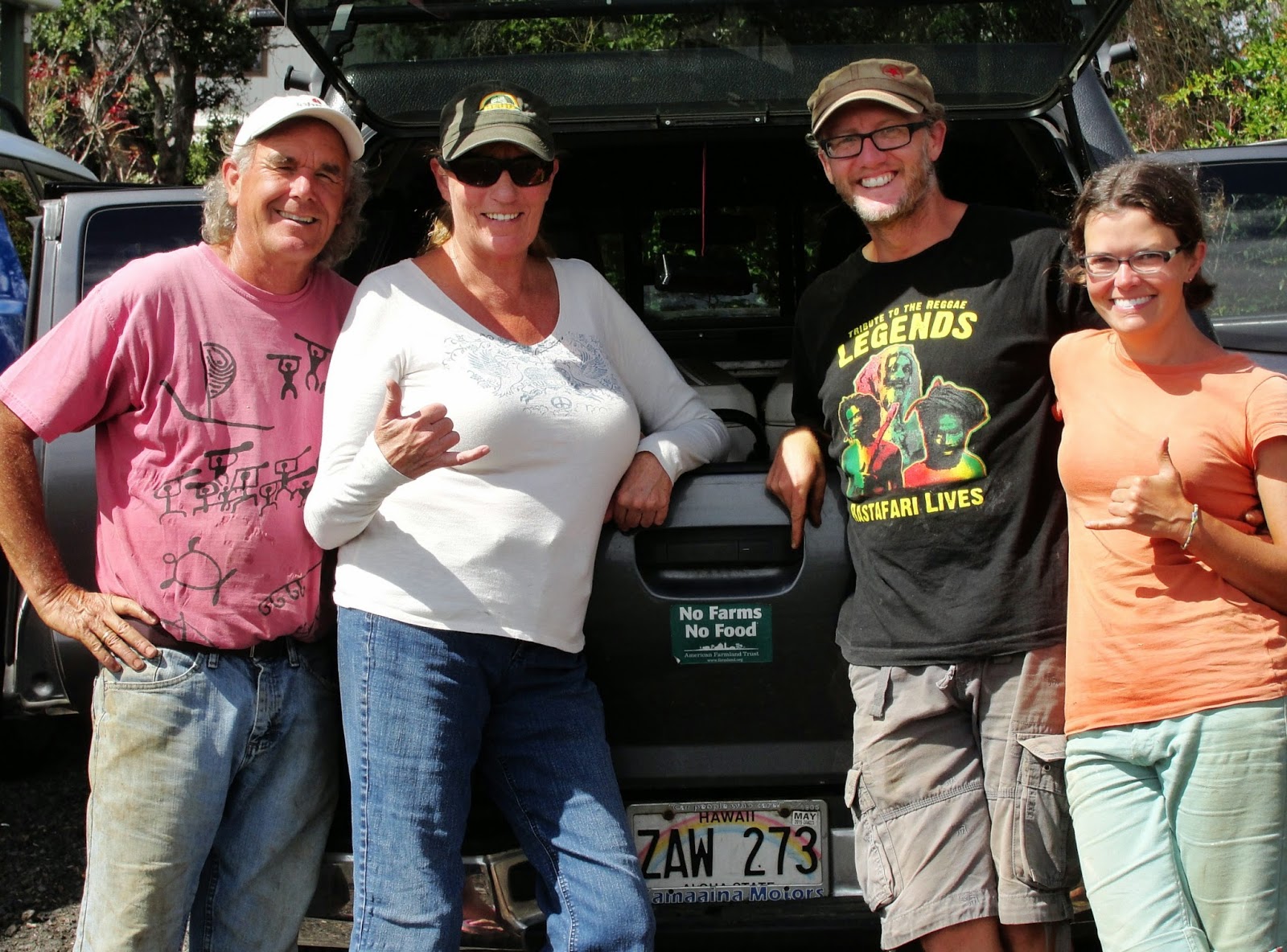
In case we haven't said it enough here or elsewhere, we really loved our stay at Earth Matters. We learned a lot from Greg in our short time and we know we will put a lot of this knowledge to use when we start our own garden. We've also made some wonderful friends that we know we'll see again someday... maybe sooner than we all realize!

mahalo nui loa, Greg and Gail!

we'll see YOU again too, farm

But change is good. We're now at our last Hawaiian farm - a coffee/mac nut farm, of course! - for a few weeks before we head back to winter in Maryland.

Hmmm. Winter in Maryland. Hmm. Perhaps we should reconsider this plan...

Thursday, February 19, 2015

Welcome to 2015, the year of the goat!

Do you have any idea how excited I was to learn that February 19, 2015 marks the start of the Chinese year of the goat?

(Do you know me in even the slightest bit, and/or do you ever read this blog? If you answered "yes" or even "maybe" to one or both of those questions, you probably have quite the idea how excited I was to learn this.)

First things first. We've seen references to the "year of the goat, also known as year of the sheep, ram."

Now, we mean absolutely no offense to our Chinese friends - it's YOUR culture, it's YOUR year, interpret it however you want.

But for the record - THIS is a goat:

smarter than your average bear
(the goat, not Patrick.. actually, Patrick too)

This? NOT A GOAT:

dumb as a box of nails
(the sheep, not Patrick)

Okay, now that we've cleared that up, we hereby bring you GOATS OF THE WORLD! Enjoy.

cheerleader goat
(Eagle Hill, Alberta, Canada)

regal goat
(Quebec City, Canada)

sweetest goat EVAH in the history of all goats
(Wakefield, Quebec, Canada)

adorable plum-eating goats
(Nemcicky, Czech Republic)

curious goats
(Picos de Europa, Spain)

tree-climbing goats
(Essaouria, Morocco)

shy goats
(Phong Nha, Vietnam)

"whatever, I'm eating" goat
(Sapa, Vietnam)

focused goat
(Luang Prabang, Lao)

headbutting goats
(Pai, Thailand)

goat TV
(Mae Sariang, Thailand)

baby goats
(Pratchum Khiri Khan, Thailand)


first Nepalese goats
(Annapurna Circuit, Nepal)

second Nepalese goats
(Annapurna Circuit, Nepal)

third Nepalese goats
(Annapurna Circuit, Nepal)

fourth Nepalese goats
(Annapurna Circuit, Nepal)

fifth Nepalese goats
(Annapurna Circuit, Nepal)

sixth Nepalese goats
(Annapurna Circuit, Nepal)

seventh Nepalese goats
(Annapurna Circuit, Nepal)

pygmy goats
(Waikoloa, Big Island, Hawaii)


smiley goat
(South Point, Big Island, Hawaii)

Goats were strangely absent from our photos from Portugal, Turkey, Cambodia and Australia. That clearly means that we need to go back to those countries and spread the goat love...

Happy 2015!

Friday, February 13, 2015

Every-day-is-Friday five: songs about places we have been.

We would sing the song for days while in a particular city. Sometimes we sang it for weeks before we visited the city, and sometimes we couldn't get it out of our heads for weeks after leaving the city. (Sometimes this made us want to cry.)

Here are five songs about cities we've visited on this trip, in no particular order... complete with links to YouTube videos so that YOU can get the song stuck in YOUR head for days.


And now, as our return to Maryland (and therefore "real life") is more and more imminent, I can't seem to get (Don't Go Back To) Rockville out of my head. Go figure.

What are some of your favorite songs about international cities?

Sunday, February 1, 2015

On transitioning back to US soil (also known as culture non-shock).

One of my strongest memories of Nepal was watching two women break a pile of small rocks into even smaller rocks by hand. We were in a taxi going from Birithati back to Pokhara after 18 days hiking the Annapurna Circuit. The 30-minute taxi ride cost us $20 (probably a combined week's salary for these women). Normally we would've looked for a public bus but we were tired, and it was getting late, and there weren't many other options at that hour, so we paid the $20.

There are many things I will never forget about Nepal - the beautiful mountains, the gorgeous valleys, the prayer wheels, the adorable yaks, crazy smog-filled Kathmandu... and the image of those two women blankly staring at us as our taxi drove around their pile of rocks and sped off down the road.

A few days later we flew from Nepal to Perth. Our 20-minute bus ride from the airport to the central business district cost us $4 each. We went in search of a bathroom and found a Target - our first in 18 months. I walked in and saw the bathing suits. "I need a new bathing suit," I thought. I even stopped to peruse them. And then I caught myself, chided myself, and continued my bathroom search. "Want" is not the same as "need."

Our next stop in downtown Perth was the grocery store. We walked into Woolworth's and spent 30 minutes perusing all of our options for our picnic lunch. "Let's get cheese! And lunch meat! And tomatoes!" "And bread, snacks! Oh, and fruit! And of course peanut butter. And maybe some chocolate."

We had just spent 18 days in the mountains of Nepal not knowing where or when we would eat our next meal, but knowing it would be the exact same thing we'd had the day before (rice for lunch, noodles for dinner, or vice versa), and that it would cost us about $3 each. The vegetables we would eat were locally grown and seasonal, and the eggs were from the chickens wandering around the restaurant's lawn.

That morning in Perth at Woolworth's, we paid $21 (and 30 minutes of our time) for our small bag of lunch supplies. Our apples were from New Zealand; our peanut butter was full of sugar.

Culture shock? More like culture hard-slap-in-the-face.

We absolutely loved our time in Australia, but for a while I would continue to be appalled at the cost of food, the cost of dining out, the cost of transportation, the cost of everything. A simple lunch on our day trip to Fremantle would've been at least $20 each (so we packed a lunch from the grocery store instead - this time, $13 total - almost the same cost as our two flat whites at Gino's that morning). The center of Glenelg was a long strip of spendy restaurants and expensive ice cream shops, and our hotel had a casino. At the night market in Darwin, I watched people eat half of their small-and-overpriced food cart dinner and drink half of their small bottled water, then throw the rest in the trash, plastic and all.

Coming off seven months in some of the poorest countries in the world, all of this was a pretty painful re-entry into western life. Eventually we got past the excess, the waste, and the rampant obesity (Jamie Oliver doesn't have a Ministry of Food mission in Australia for nothing). We would occasionally indulge in $4 chocolate bars and $8 pints of beer. We would spend $150 for a day trip down the Great Ocean Road. We would pay $25 each to visit a pretentious museum in Hobart and $38 on a mediocre Vietnamese dinner in Melbourne.

For a while, every time we spent money we would say "remember when we could live for a week on that amount?" After a while, this changed to "remember when we paid a lousy $2.50 for a fantastic cup of coffee at Oblique?"

moving right along...

Enter Hawaii - Oahu, to be exact. We, being us, took the public bus from the Honolulu airport the morning we arrived. For a while we were the only white people amongst the passengers. As we listened to random conversations in Japanese, Hawaiian slang, and various other languages we couldn't easily identify, I had to keep reminding myself that we were actually back in the United States. (I also had to do this every time I looked out the window and panicked that the bus was on the wrong side of the road... haha.)

After that bus ride, though, we were definitely back in familiar territory. Instead of ordering flat whites, we ordered a cup of coffee. Instead of wondering whether $1.99/litre for petrol was cheap or expensive, we instinctively knew that $3.50 for a gallon of gas was a pretty good deal. Instead of buying crisps, biscuits and plonk at the supermarket, we bought chips, cookies and cheap wine. Instead of paying with colorful money that came in various sizes, we used boring same-sized US dollars and didn't have to mentally convert what our purchase was actually costing us.

But was there culture shock when we hit US soil? Coming from the land down under, not really.

Hawaii has probably been the easiest transition from Australia back to the US. Tourists spend amazing amounts of money to sunbathe on beaches with thousands of other tourists before heading back to their expensive all-inclusive resorts. Food prices are crazy; eating out is damn near impossible on our budget; lodging is ridiculous. It's easy to see why poverty is so high here. The only thing that doesn't cost an arm and a leg is public transportation - but good luck finding a bus that actually runs on time and more than once a day.

I understand that Australia and Hawaii are islands and the cost of transporting goods over thousands of miles of water must be factored into prices... But doesn't that suggest looking into using the resources you have, instead of importing things you think you need? Every culture has done this for thousands of years and survived just fine. They didn't need gluten-free blahblahblah or Ben & Jerry's ice cream or fast food. That's one thing that conquering societies have never mastered - if you can't find it in nature or make it locally, perhaps you don't really need it.

Cost of living aside, there has been one interesting shift in cultures from Australia to Hawaii and that's a rather obvious lack of trust. It's not that the local residents are mean. They just aren't very friendly, generally speaking (unless you are with another local, or you show interest in something they are selling). Hardly anyone raises their head as we pass them on the street. People at the grocery store don't make eye contact. Folks don't seem to know - let alone trust - their neighbors.

Surely part of this is due to transient mainland snowbirds and hoardes of international tourists passing through every day. Why bother to get to know you, when you'll be gone tomorrow? The other part is that it's just stereotypical American behavior. We build fences. We buy guns to protect ourselves and our property. We're suspicious until you give us reason not to be. It's such a change from Australia where almost any stranger would say hello and everyone would stop to chat (and chat, and chat some more) if you opened that door.

It also seems that everyone here has a dog. A mean dog, that must be tied up, that barks incessantly when you walk past. Our farming roommate was even warned to carry a stick on her morning runs. Petty crime is a big problem on the islands, and beyond that a lot of locals grow their own pot, so guard dogs make some sense. But being lunged at by a snarling canine as we walk to the market just adds to the general feel of mistrust.

Don't get me wrong, we are loving our time in Hawaii too.

what's not to love?

However. We're not looking forward to tall fences separating us from our neighbors - we want to know who lives next door. We don't want to live where people look confused when you say hello, or look put out when you ask for help. We like waving to drivers as we pass them on the road. We want to enjoy what's right around us, whether it's the like-minded company we keep, or the food we pick from the backyard, or the entertainment that nature provides.

We will let these values guide us when we are "back" (whatever "back" means). We'll try to ingrain a little of that Australian (and Canadian, and SE Asian) hospitality into our American culture.

And when we are "back" I will remember those two Nepalese women and the distinction between "want" and "need" when considering how to spend my boring same-sized US dollars.  For example...

want

need